Navel Piercing: Feasibility, Pain, Healing, and Initial Jewelry

Are you considering a navel piercing in Lille and have questions about feasibility, pain, or initial jewelry? At Kawaii Place, we take the time to evaluate each body type to ensure the placement is possible under good conditions. In this article, we explain what to expect during a navel piercing appointment, what jewelry we use at the studio, and what you need to know before getting one.
1. Who is a navel piercing for?
Body type, placement, difference between compatible and incompatible navels
Not all body types are compatible with navel piercings: contrary to popular belief, this piercing doesn't just depend on the "style" of the navel but rather on how the area is shaped at rest and in motion. The feasibility of the piercing does not directly depend on the size of your stomach but on the morphology of the navel itself.
For a navel piercing to be performed under good conditions, the anatomy must allow for stable placement of the jewelry over time. Depending on the shape of the navel, the presence or absence of a small skin fold, the depth of the area, and how the stomach folds when sitting or bending, some navels will be compatible... and others, unfortunately, will not.
In most cases, a navel can accommodate a classic placement. In others, an inverted navel or another type of placement may be more suitable. It can also happen that no option is recommended if the area is under too much pressure, lacks support, or doesn't allow the jewelry to stay well-positioned.
Also note that no one has a perfectly symmetrical body: a perfectly centered navel is often an optical illusion created by the piercer rather than a perfectly "geometric" positioning. As soon as you move, the navel slightly changes shape, and the piercing can take different angles, which is completely normal.
Don't panic if your navel piercing doesn't appear perfectly straight in certain positions: you can often visually camouflage it with certain types of jewelry.
2. What happens during the appointment?
Placement, initial jewelry, duration, pain
For this part, we can only explain how we work at our shop, not how other professionals—or less professional ones—work!
We always allocate at least 30 minutes per piercing appointment. This time allows us to properly explain the procedure, aftercare, help you choose the jewelry, sterilize the selected jewelry, and most importantly, take the time to do things under good conditions. For us, doing our job well means this too.
The piercing act itself is very quick, and the pain is usually just as brief. In the first few hours or even days, it's possible to feel a slight discomfort or a mild sensation of warmth.
3. Does it hurt?
Feeling, tension, apprehension, superficial but sensitive area
As with many other piercings, pain remains a very personal experience: from one person to another, the sensation can vary depending on sensitivity, stress, apprehension, or simply how the body reacts at the moment.
The navel piercing goes through a rather superficial area, but that doesn't mean the area is insensitive. The process can be daunting if you're very apprehensive, but the piercing act itself is, once again, very quick.
Often, it's not so much the pain that leaves a mark as the stress just before the appointment. The most important thing is to be well-supported by a good professional and not hesitate to ask questions before the procedure and jewelry placement.
4. What jewelry is used initially?
Shape, length, material, why we don't just use anything
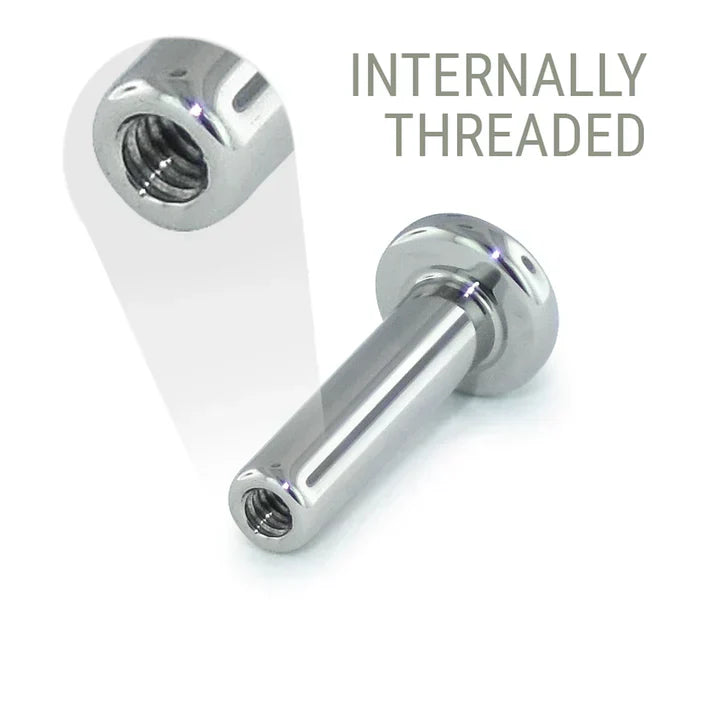
For a navel piercing, the initial jewelry must be a curved barbell, also known as a banana bar. This is the appropriate jewelry to start the healing process correctly, and it must be kept for the first 6 months. A ring can be considered after 6 months of healing.
We only use high-quality titanium or 14k gold jewelry: never steel, never plated! The goal is to minimize reactions and ensure good biocompatibility from the start.
Poor quality jewelry can lead to swelling, redness, itching, and even discoloration of the skin.
5. How long does it take to heal?
Long healing time, area subject to friction, sometimes capricious healing
Navel piercings require a long healing period because it is an area subjected to daily friction, tension, and movement, which can easily slow down the process.
Even when the outside appears fully healed, it doesn't mean the process is complete. The navel may seem fine for a while, then become re-irritated at the slightest snag, constant friction from clothing, after a premature or poor-quality jewelry change.
It's also a healing process that can be capricious: some people will have almost no issues, while others will face phases of irritation, even when being careful. This is precisely why patience is essential with this piercing.
6. The most common mistakes
High-waisted pants, sports, sleeping on it, snagging, changing too early, wrong jewelry
The most common mistakes are often related to clothing friction and rushing. For example, high-waisted pants, overly tight clothing, or fabrics that constantly press on the area can quickly cause healing problems.
Sports, repeated movements, sleeping with pressure on the area, sleeping directly on it, or accidentally snagging the jewelry can also complicate healing. Even a small bump can be enough to trigger discomfort or redness again.
Another very common mistake: changing the jewelry too early because "it seems to be getting better." Visual improvement does not mean the area is truly healed, and it's important to remember that jewelry choice also matters a lot: an unsuitable shape, size, or material can make healing much more complicated and lengthy.
7. The most common complications
Irritation, migration, rejection, redness, bumps, when to worry
Don't panic: navel piercings can experience several complications or difficult phases during healing; it happens. The most frequent issues remain irritation, persistent redness, and small bumps related to too much impact/friction on the piercing.
In some extreme cases, migration (a gradual displacement of the piercing) or even rejection (when the body begins to expel the jewelry) can also be observed. These are situations that should not be ignored but are quite uncommon.
If the appearance of the area deteriorates, the jewelry seems to move abnormally, the skin thins, or the irritation persists despite precautions, then you should not procrastinate and you should seek the advice of your piercer.
8. Our advice for good healing
Clothing, cleaning, patience, follow-up, downsize if needed
For proper healing of a navel piercing, it is crucial to minimize friction and trauma to the area. Wearing loose-fitting clothing that doesn't compress the area greatly helps with good healing in daily life.
You should also follow the recommended aftercare without adding anything, avoid manipulating the jewelry, and give the piercing time to stabilize. With this piercing, patience plays a huge role: rushing is often counterproductive.
Follow-up can also be very useful during healing: at the shop, we offer a walk-in check-up one month after the piercing for our professionals to ensure everything is going well and to discuss the ongoing healing process. Depending on the area's evolution, a jewelry adjustment (downsizing) may sometimes be considered if necessary. The goal always remains the same: to keep jewelry that is adapted to the anatomy, morphology, and biocompatibility.
9. When can the jewelry be changed?
Not too early, difference between visual improvement and true healing
The jewelry should not be changed too early, as this could cause healing problems. Even if the area appears clean, less sensitive, or visually better, it does not mean that the healing is complete—far from it. Therefore, it is important to differentiate between visual improvement and true healing.
Before changing the jewelry, it's best to ask your piercer for advice and ensure the area is truly ready. We recommend avoiding any jewelry changes during the first 6 months of healing.
A navel piercing is therefore not a piercing to be taken lightly: its feasibility truly depends on the body type, its placement must be carefully considered, and its healing often requires more patience than one might imagine, like all piercings. However, when done correctly with appropriate jewelry and serious follow-up, it can evolve very well over time.
At Kawaii Place, we always take the time to check if the placement is possible under good conditions before piercing. If you have any doubts about the compatibility of your navel, the choice of jewelry, or the healing process, the simplest way is to come and show us the area so we can advise you best :)
Are you unsure about the feasibility of a navel piercing or do you have a question about healing? Contact us and we will guide you in an instant.
Call us at 06 59 00 24 36, contact us via tattookawaii@gmail.com, or find us at 38 rue des postes in Lille from Monday to Saturday.